


Nationwide hiring should be a growth lever. For too many companies, it has become a liability.
When a company decides to hire someone in a new state, the process that follows is rarely simple. Tax registrations, unemployment accounts, wage law reviews, local posting requirements, and payroll updates are just the beginning. These are not one-time tasks. They represent an ongoing operational burden that compounds with every new state, every new hire, and every legislative change. For many HR teams, the calculus becomes straightforward: the compliance cost of hiring across state lines is too high, so they don't.
That reluctance has real consequences. It limits talent access, restricts business growth, and forces companies to pass on qualified candidates simply because of geography. The problem is not ambition. The problem is infrastructure.
To understand the scope of that problem, we created the Multi-State Hiring Compliance Burden Index. We surveyed HR, payroll, staffing, and business professionals who employ or place workers across multiple U.S. states to learn what hiring concerns affect them most. The results tell a clear story: nationwide hiring has become the norm, but the infrastructure required to pull it off hasn't kept pace.
The Hardest States to Hire In
FoxHire surveyed 1,000 HR, payroll, staffing, and business professionals who hire across multiple states. When asked which states create the most compliance difficulty, California ranked first overall at 36.40% and New York second at 32.80%. HR and people operations professionals rated California even higher at 41.72%, the highest score any segment gives any state in the entire survey. Still, when the data is filtered by role, New York ranks first in three of the five professional segments surveyed.

Compliance difficulty didn't spread evenly across the country. It concentrated in a small group of coastal and high-regulation markets that professionals flagged, consistently, as the places making their jobs harder. Respondents who hired in Texas, Florida, and Georgia didn't flag those states as the source of the problem. The ones hiring in New York and California did.
States Ranked by Difficulty
California and New York are in their own tier. New Jersey, Illinois, and Pennsylvania each have significant regulatory environments of their own, and all three still came in below 12%. The drop from second place to third is more than 21 percentage points. Those states create real compliance friction. That friction just doesn't approach the scale of the top two.
Large, regulation-dense states dominate the list because they stack requirements that don't exist elsewhere. Employers hiring across state lines juggle wage laws, classification standards, pay transparency rules, and disclosure mandates that vary by jurisdiction and compound with every new state they enter.
California’s AB 5 law is a clear example. It tightened the rules around independent contractor classification and forced companies nationwide to rethink how they engage contractors. When a state builds that kind of reputation, it starts shaping expansion decisions before legal or HR teams are ever formally consulted.
The Roles That Put New York First
Recruiters • Benefits Administrators • Payroll Teams
Recruiting professionals, benefits administrators, and payroll teams all ranked New York above California. These three roles deal with compliance requirements that fire at specific points in the employment lifecycle: pay transparency disclosures before an offer goes out, leave and benefits administration once someone is hired, and withholding and wage notice obligations every pay cycle. New York's requirements in each area are layered and locally complex, with New York City ordinances adding requirements on top of state law across all three functions. Payroll teams gave New York its widest margin of any segment: 35.44% vs. 29.11% for California.
New York’s position at the top of the list reflects the real, day-to-day friction in the hiring funnel. The state has some of the most comprehensive pay transparency and pay equity laws in the country, which means those hiring must disclose salary ranges before an offer goes out. Paid family leave mandates and New York City-specific benefits ordinances create ongoing administrative obligations once someone is hired. Layered local tax jurisdictions and county-level wage notice requirements land on payroll teams every pay cycle. Unlike California, where the burden is concentrated in classification and enforcement risk, New York distributes its compliance requirements across every stage of the employment relationship.
The Roles That Put California First
HR & People Ops • Legal & Compliance Teams
HR and people operations professionals and legal and compliance teams both ranked California first, at 41.72% and 35% respectively. The HR figure is the highest score any segment gives any state in the entire survey. Both roles share the same underlying concern: what happens when compliance breaks down. California's worker classification rules, Private Attorneys General Act (PAGA) enforcement mechanism, and volume of employment litigation make it the dominant risk for teams managing employment policy and legal exposure across multiple states.
The states that rank highest for legal and compliance teams tend to have the most active enforcement environments, not just the most regulations. Massachusetts and New Jersey both scored 15% among legal and compliance professionals, tied for third behind California and New York. Both states have expanded wage and hour enforcement in recent years and maintain employee-favorable court systems. For legal teams managing multi-state exposure, they represent the next tier of risk below the top two.
What the Differences Between Roles Actually Tell Us
The consistency across groups matters as much as the individual rankings. California and New York appear at or near the top whether you're talking to a recruiter, a benefits manager, or a compliance attorney. These two states don't just cause problems for one department. They create headaches across the entire organization, for completely different reasons.
When different departments flag the same states independently and for different reasons, it stops being a matter of opinion and becomes a documented operational pattern. The problem isn't which states a company enters. It's that no single department owns the full picture when they should.
Companies Are Hiring Everywhere. Their Compliance Isn't Keeping Up.
78% of survey respondents expanded their workforce into at least one new state in the past 12 months. Before remote work became common, companies hired locally or regionally, but COVID-19 accelerated that shift faster than anyone anticipated. More than half of respondents expanded into at least two new states last year. Multi-state hiring is now the norm, not the exception.
While the ability to hire anywhere grew rapidly, the internal mechanics required to do it properly did not keep pace. Every new state requires its own registrations, accounts, and compliance reviews, and unlike onboarding a new employee, that work doesn't end once you've checked the boxes the first time. It's why 36% of employers need a full month or longer before they feel genuinely confident they're compliant somewhere new. During that gap, hiring slows, caution sets in, and momentum stalls in a market where timing matters.
30.8% say it takes three to four weeks to feel fully set up and confident in a new state, accounting for tax registrations, payroll configuration, required notices, and policy alignment. Only 10% report getting fully operational in under a week. The time cost of compliance setup is a hidden drag on hiring velocity. Every week spent resolving registrations and researching local rules is a week a candidate is waiting, or a role is going unfilled.
Nearly Half of Employers Have Delayed Hiring Because of State Rules
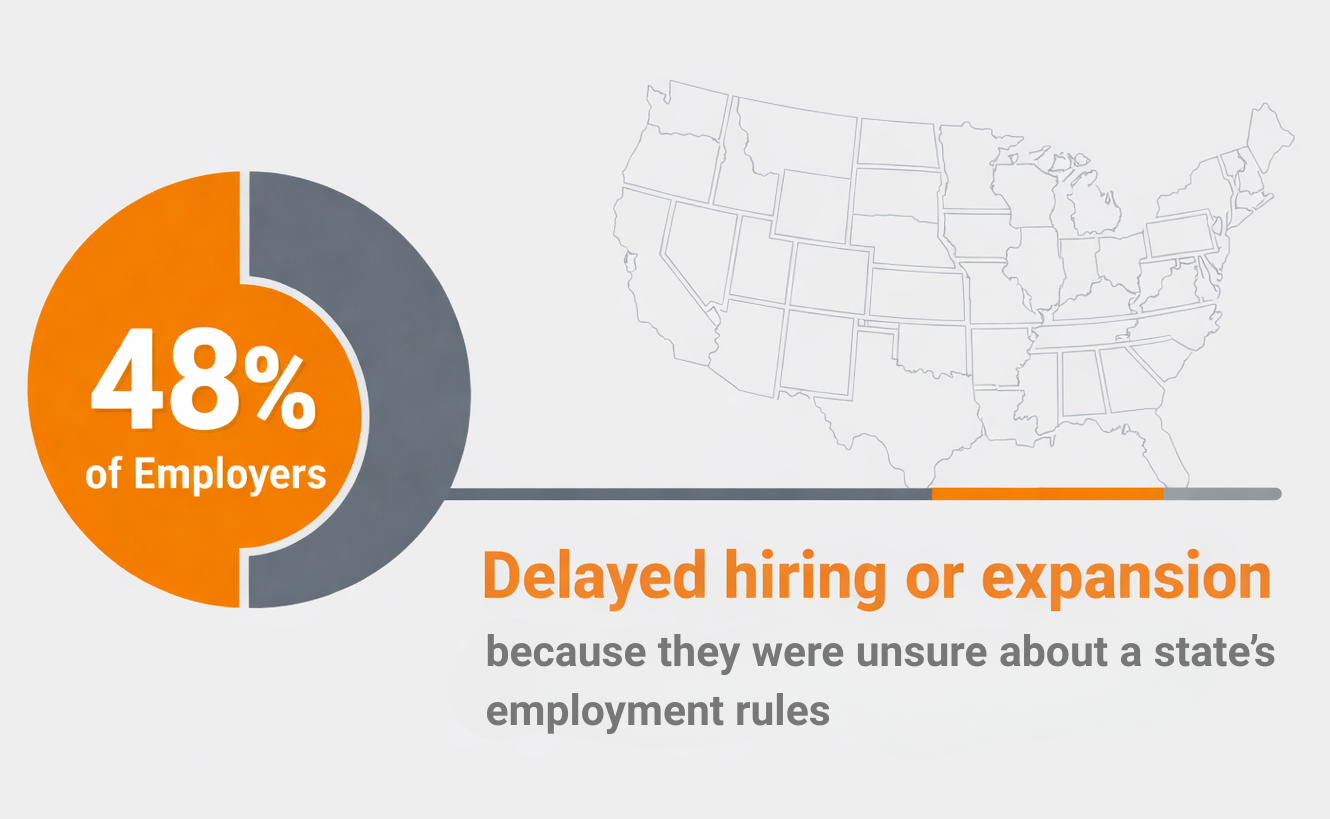
Nearly half of respondents, 48%, delayed a hiring decision or expansion because they weren't sure about the rules in a given state. This statistic shows that companies want to hire, but stop short because the regulatory picture wasn't clear enough to move confidently.
The U.S. Department of Labor's proposed February 2026 rule on independent contractor classification would walk back the Biden-era standard, but it offers limited relief for multi-state employers. A worker who qualifies as a contractor under the new federal framework may still be classified as an employee under California, New York, or New Jersey law.
Add varying pay transparency requirements, local wage standards, and state-specific tax systems into the mix, and it's not hard to understand why 21% of respondents ended up pushing back a start date just to sort out compliance before bringing someone on.
The picture becomes even more concrete when examining the outcomes employers have experienced in the past 12 months. Only 20.1% said none of the listed adverse hiring events had occurred. That means 79.9% experienced at least one adverse hiring outcome because state-by-state compliance rules made hiring harder. These outcomes included delayed start dates (20.9%), limiting remote hiring to a short list of states (18.5%), asking candidates to relocate to be eligible (17.6%), and lowering a pay offer to cover compliance costs (9.6%).
50% Have Told a Qualified Candidate "No." Here's Why.
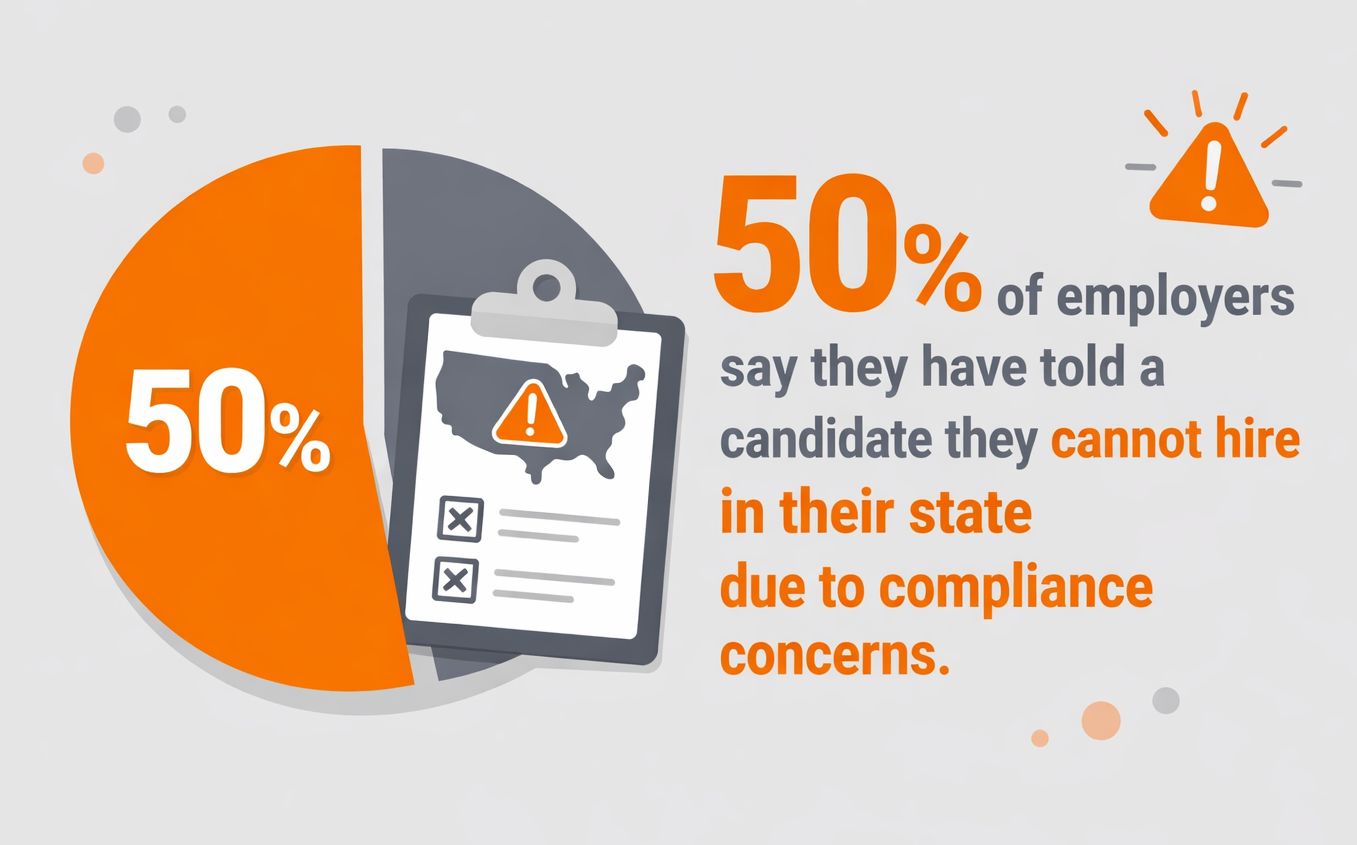
Half of employers have told a candidate they couldn't be hired in their state because of compliance concerns. That conversation typically happens late in the process, after both sides have invested real time, sometimes in a final interview or during offer negotiations. It doesn't make headlines, or show up in hiring data. But it happens regularly, and it's one of the quieter ways that regulatory complexity shapes who actually gets access to job opportunities.
That burden doesn't disappear once someone is hired. In many cases, it intensifies, and nowhere more so than in payroll. 32% say payroll taxes and registrations generate the most compliance work, and 30% say payroll mistakes are their single biggest fear when entering a new state. That fear is grounded in experience: 25% have already paid a penalty or fine tied to multi-state compliance in the past two years. A missed withholding or a registration error can create penalties and employee dissatisfaction at the same time, which is why payroll has become a front-of-mind concern that now factors directly into decisions about where to hire.
The survey also captured a less visible form of exclusion. When asked whether they had decided not to hire or place someone in a specific state because compliance felt too risky or complicated, even without telling the candidate directly, 43.7% said yes. Combined with the 50% who told a candidate no directly, the data shows that compliance-driven hiring exclusions are far more widespread than any single number captures on its own.
The financial exposure is consistent with the operational strain. In the past 24 months, 23.8% of respondents missed a registration, filing, or reporting deadline. Another 24.7% had to issue back pay or a wage correction. And 24.8% said the most damaging compliance mistake their organization could make would be a government audit. These are not low-probability risks. They are outcomes that roughly one in four multi-state employers has already experienced.
State Rules Vary and Local Rules Are Making It Worse.
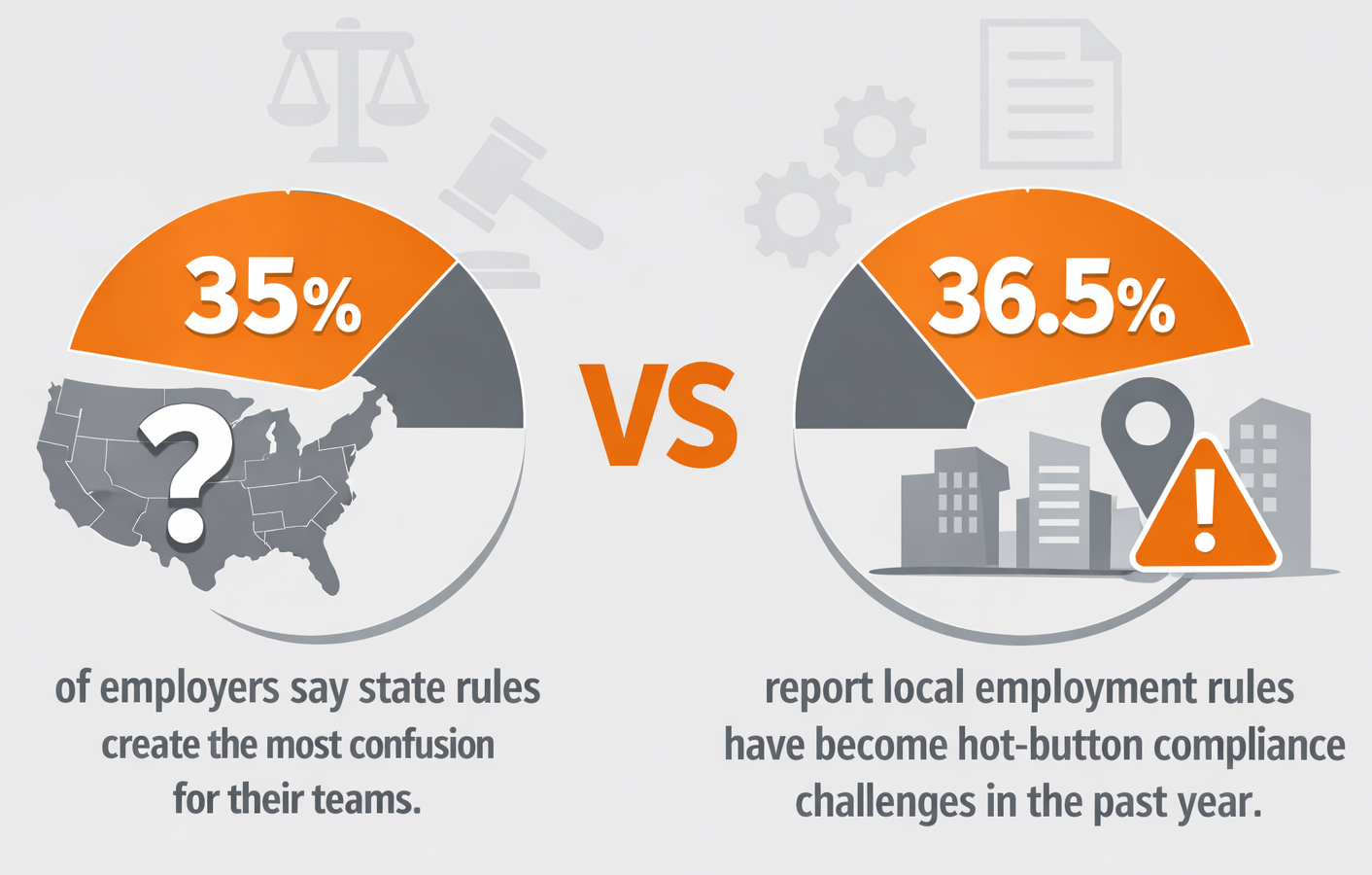
More than a third of employers say state rules create the most confusion for their organization, and 36.5% report that local employment rules have become a significant compliance challenge in the past year. These figures don't represent just one department. From benefits to legal to recruiting, professionals across the organization are struggling to balance state-level and local requirements simultaneously. Most state employment laws exist for good reason. Pay transparency, classification protections, and local wage standards all serve real policy goals.
But the friction comes from how much these laws vary from state to state. Some employers manage that complexity by simply narrowing the list of places they're willing to operate. It rarely gets framed as opposition to worker protections. It's usually called capacity management: weighing exposure against opportunity and deciding a given jurisdiction isn't worth the risk right now. The outcome is that stronger protections in certain states can quietly coincide with fewer employers willing to hire there. Nobody announces that decision. It just shows up in the map of where a company is and isn't willing to operate.
The survey put that dynamic directly to respondents. When asked whether the growing patchwork of state rules is ultimately helping or hurting workers, only 18.6% said mostly helping. The most common response was “helping and hurting equally” at 32.7%. But 25.4% said the regulations are mostly hurting workers by limiting where companies hire. An additional 11.1% said the rules mostly help large companies while hurting small ones. That adds up to more than a third of respondents believing the net effect of growing state-level regulation is negative for workers.
"Salaries for the average American are not just remaining flat due to corporate greed as many claim in the media. Rather the cost of employment has risen drastically for employers across the nation due to ever-increasing regulation. Protecting worker rights is absolutely necessary, but there is a balance, and in some states the regulation costs and risks outweigh the benefits of hiring in those states. So many employers just don't hire in those locations"
— Colin LaBeau, President of FoxHire
Employment Data Tells the Same Story
A FoxHire analysis of Bureau of Labor Statistics nonfarm employment data from 2019 to 2024 found that states consistently ranked as the most difficult for compliance, including California, New York, New Jersey, and Illinois, showed measurably slower employment recovery and growth compared to lower-regulation states like Texas, Florida, Tennessee, and Georgia. California only grew 3.0% and New York 0.8% from 2019 to 2024. Texas grew 10.3% and Tennessee 8.1% over the same period.
The states where employers report the most friction are the same states where job growth has lagged. This is not a statement about whether those regulations are good or bad. It is the practical reality that compliance complexity carries a cost, and workers in those states bear part of it.
For the full state-by-state data analysis, see: FoxHire's State Complexity Index
Technology as a Compliance Safety Net
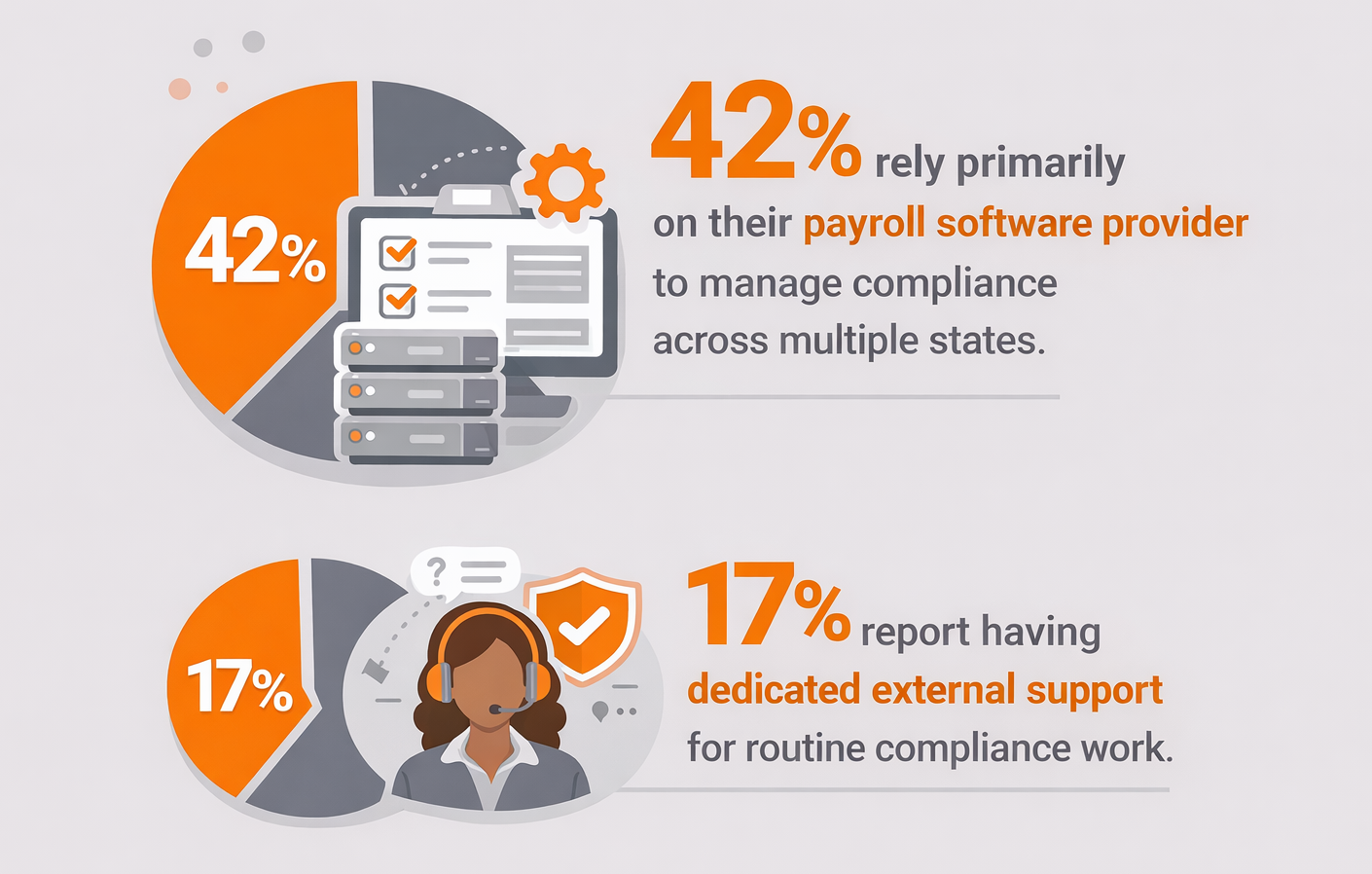
When expanding into a new state, most companies don't start by calling outside counsel. They open their payroll software. 42% rely primarily on payroll software to manage multi-state compliance, and only 17% have an ongoing retainer or dedicated external support for routine compliance work. This means the vast majority of companies are either handling it internally or reaching out for support only when a specific problem arises.
Payroll software earns that trust because it does genuinely useful work. It calculates tax rates, tracks withholding rules, processes filings, and cuts down on manual errors. But there is a meaningful difference between applying rules and interpreting them. Software can't weigh gray areas, account for how aggressively a state pursues violations, or exercise the kind of judgment that complex, multi-jurisdictional compliance increasingly requires. When the rules vary this much across this many states, having everything in one system doesn't mean you're fully covered.
That gap is also visible in how frequently organizations turn to outside legal or compliance help for routine employment tasks. 38.2% use outside help a few times per year, 18% use it monthly, and 8.8% use it weekly. Only 18% say they never use it. That pattern describes a recurring, ongoing cost of compliance management that most organizations carry quietly, in the form of legal retainers, ad hoc consultations, and the time HR teams spend researching rules that change without warning.
A National Labor Market With Local Limits
Hiring has gone national, but the rules governing employment largely haven't. Employers are expanding into new states and bringing on remote talent across the country while the compliance infrastructure struggles to keep pace. Nearly half of respondents have delayed a hiring decision because the regulatory picture wasn't clear enough to move forward, and 36% still need a full month before they feel genuinely confident operating somewhere new.
There aren't fewer jobs overall, but there are fewer places where companies feel comfortable creating them. That isn't a strategic choice so much as the cumulative weight of a patchwork of state and local rules that keeps growing and shows no signs of stabilizing. Until the gap between how broadly companies want to hire and how prepared they actually are to do it begins to close, the friction documented here will continue to shape who gets hired, where, and when.
Methodology
The Multi-State Hiring Compliance Burden Index is based on a national survey of HR, payroll, staffing, and business professionals who employ or place workers across multiple U.S. states. Respondents were asked about expansion activity, compliance challenges, hiring delays, and their experiences with penalties.
Fair Use Policy
Users are welcome to use the findings from this study for noncommercial purposes, including academic research, educational presentations, and personal reference. Please provide proper attribution when citing this article. For commercial use or publication, please contact the authors for permission and licensing details.
Transform Your Hiring Process Today
Experience seamless hiring with our platform. Get started with a demo or sign up now!

FAQs
Find answers to common questions about our services and the contingent workforce management.
What is the Multi-State Hiring Compliance Burden Index?
The Multi-State Hiring Compliance Burden Index is an annual research study by FoxHire based on a survey of 1,000 HR, payroll, staffing, and compliance professionals who hire across multiple U.S. states. It measures the real operational burden of multi-state employment law, from setup time and compliance delays to hiring exclusions and financial penalties. The index also ranks all 50 states by compliance complexity using a weighted composite score, with New York ranking highest at 87.3 and California second at 83.9.
How long does it take a company to become compliant when hiring in a new state?
Longer than most companies expect. FoxHire's survey found that 30.80% of employers say it takes three to four weeks to feel fully set up in a new state, accounting for tax registrations, payroll configuration, required notices, and policy alignment. Another 36% say the process takes one month or longer. Only 10% report getting fully operational in under a week. That ramp-up period slows hiring velocity and often causes companies to delay or avoid expansion into new states altogether. An Employer of Record like FoxHire eliminates the setup burden by acting as the legal employer from day one.
Which U.S. states are the hardest for employers to stay compliant in?
California and New York consistently top the list across every professional role in FoxHire's survey. 36% of all respondents identified California as the most difficult state overall, while New York ranked first among recruiting professionals (40%) and benefits administrators (36%). New Jersey, Illinois, and Massachusetts round out the top five. These states have the most layered employment laws, the most active enforcement environments, and the most moving parts across payroll, leave, classification, and pay transparency requirements.
What happens if a company doesn't comply with state employment laws?
The financial and legal consequences are significant and more common than most companies realize. FoxHire's survey found that 25.3% of multi-state employers have paid a penalty, interest, or fine related to state employment compliance in the past 24 months. Another 23.8% missed a registration, filing, or reporting deadline, and 24.7% had to issue back pay or a wage correction. Beyond fines, non-compliance can trigger government audits, misclassification claims, and employee complaints that create long-term legal exposure. The most damaging outcome, cited by 24.8% of respondents, would be a government audit.
How does FoxHire solve multi-state compliance?
FoxHire becomes the legal employer for your contract workers in every state, managing payroll taxes, benefits, onboarding notices, leave compliance, and all other state-specific requirements behind the scenes. There are no subscription fees, no setup delays, and no need to open legal entities in new states. For the 79.9% of employers who experienced an adverse hiring outcome due to multi-state compliance in the past year, an EOR partnership removes the friction that limits where and who they hire. FoxHire serves recruiters, staffing agencies, and HR teams across all 50 U.S. states.
Still have questions?
We're here to help you with any inquiries.